some art books
Jan. 30th, 2024 06:31 pm![[personal profile]](https://www.dreamwidth.org/img/silk/identity/user.png) portico
portico in my job i see and deal with a lot of exhibition catalogs (publications put out by museums to accompany major exhibitions) but i rarely sit down and read them cover to cover. recently, i did so with two.
the first was The Sassoons, by Esther da Costa Meyer and Claudia J. Nahson, published on the occasion of an exhibition of the same name at The Jewish Museum in New York. It was up from March to August of 2023, and focused on the Sassoon family of Baghdad, then Mumbai, and finally London as patrons and collectors of art, and what their collecting said about their religious and cultural identities.

I didn't see the exhibition in person, but the catalog is beautiful--hardcover with gilt page-edges and not so huge to be uncomfortable to read. The catalog is organised vaguely chronologically, and as such it starts with Judaica collected by and commissioned by the family while they were still in Iraq, and after moving to India. The family (David Sassoon 1792-1864 and his many children) left Baghdad due to religious persecution and set up business in Mumbai by 1832. The catalog does a good job of not shying away from the less exemplary parts of the family business--such as how much of it relied on the opium market, and the way the family sided with the British ruling elite against the native population and kept themselves separate from the Jewish population which had been in India for generations and who had opened their arms as well as their places of worship to the Sassoons when they first arrived.
As someone who knows very little about Judaica, I enjoyed this section very much, in particular the ketubot (marriage contracts), which were truly beautiful documents. The catalog includes several, which means you can see how ketubah fashions changed over the years. This one, recording the marriage of Reuben David Sassoon and Kate Ezekial, was my favourite by far.

The organizers of the exhibition clearly went out of their way to highlight the collections and contributions of the women of the Sassoon family, and the catalog reflects that. In later chapters there are huge sections devoted to Sybil Sassoon and Hannah Gubbay, but I appreciated the highlighting of the women actively involved in art patronage during this period of the family's history, especially since so much attention is otherwise given to the men who were building cemeteries and synagogues. (The cemeteries and synagogues were mentioned too, obviously.)
My reason for interest in this book and this family lies at the feet of one of my most problematic hobby-horses: probably queer rich people who built cool houses in the 1920s. One of these is a Sassoon, Philip, who lived from 1888-1939 and who, along with his sister Sybil and their cousin Hannah, formed the end of the family's transformation from Baghdadi Jewish to fully British (their cousin Siegfried, well known for his war poetry, is also represented here but is something of an outlier as he was raised Catholic and didn't meet most of his Sassoon family until he was an adult). Philip was a member of Parliament and Sybil married a marquess. They were also great friends of John Singer Sargent, and he painted them--and especially Sybil--several times. The catalog also features two younger Sassoon cousins I was unfamiliar with, who collected Asian art.
.jpg)
.jpg)
On the whole, I was impressed with the way the authors managed to balance celebrating a truly remarkable family with the truth that while it may be possible to assimilate fully* into a powerful society as a member of a marginalized group without embracing its colonizing heritage, the Sassoons did not manage it. They did build some beautiful houses, though.
the second catalog i read was Frolic of the Mind: The Illustrious Life of Rose O'Neill by Sarah Buhr, published to accompany an exhibition of the same name at the Springfield Art Museum in 2018. Rose O'Neill (1874-1944) was the creator of the Kewpie, and later the Kewpie doll, as well as the first woman cartoonist published in America. I came across Rose in Perkins Harnly's biography and wanted to know more about her (this was enlightening in a few ways--i also learned that the author of the Harnly bio mixed up which of Rose's houses burned down).**
i sought out an exhibition catalog in particular because i was interested in the personal series of drawings she did which she called her "Sweet Monsters," and which I could only find a few images of online. The catalog included many more of them, as well as images of sculptures she made. it also clearly made the link between the forms of the monsters, which were Rose's version of fauns, and the landscape which surrounded her at her home in the Ozarks.

The Mountain, 1921
The catalog is half text and half plates, with essays focusing on Rose's work as a feminist and suffragist, her life in the Ozarks, and her poetry. All of the contributing writers hailed from Missouri institutions, which really worked in its favor, i think. you're left with the impression that Missouri loves Rose O'Neill as much as she loved it. which was quite a lot indeed.
finally, i wanted to mention a lovely little art book i bought on impulse last weekend and read yesterday. Eric Ravilious: Landscapes & Nature is not an exhibition catalog, but it was published by the Victoria & Albert Museum, which holds much of his work. It's also by Ella Ravilious, his grand-daughter, which is fun. Ravilious primarily worked in watercolor, which in general i find less visually interesting than other media, but every time i've seen a work by him i've been struck by it. this book was a good introduction.
to start with, Ravilious (1903-1942) was much more than a watercolorist. professionally, he was primarily a printmaker, embracing the very old technique of woodcutting in school and eventually becoming a master of it.
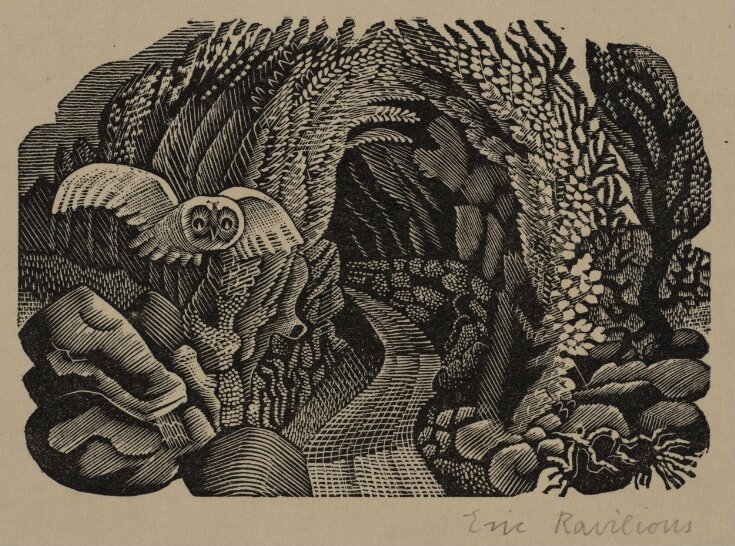
The Natural History of Selborne, 1938
his training was in design, and he worked as a commercial artist all his life. he was working-class, the son of shopkeepers, and doesn't seem to have had an expectation of being able to do art for art's sake. however, he did move out of london and to the country to give himself more inspiring landscape to paint.

Cuckmere Haven, 1939
the book contains a number of pieces by the artists Ravilious was inspired by, which is a thing i always enjoy seeing. it touches on the people in Ravilious' life with whom he conspired and collaborated, including his wife, Tirzah Garwood, an artist in her own right, but i would have appreciated even more of it. i also would have appreciated seeing some of Garwood's own work, especially since pieces by some of Ravilious' male contemporaries were included.
Ravilious was an official war artist and seems to have relished the role.*** sadly, he vanished in Iceland in 1942 at the age of 39.
*The authors largely restrained themselves from examples of the prejudice members of the Sassoon family faced, limiting it to a single, powerful paragraph. Anyone who was unaware of Virginia Woolf's antisemitism before will not be after reading this book.
**It was the family home in Missouri, Bonniebrook, not the house in Connecticut where Harnly lived for a while. fyi.
***can't relate, but it did give me a birthday gift idea for my dad
the first was The Sassoons, by Esther da Costa Meyer and Claudia J. Nahson, published on the occasion of an exhibition of the same name at The Jewish Museum in New York. It was up from March to August of 2023, and focused on the Sassoon family of Baghdad, then Mumbai, and finally London as patrons and collectors of art, and what their collecting said about their religious and cultural identities.
I didn't see the exhibition in person, but the catalog is beautiful--hardcover with gilt page-edges and not so huge to be uncomfortable to read. The catalog is organised vaguely chronologically, and as such it starts with Judaica collected by and commissioned by the family while they were still in Iraq, and after moving to India. The family (David Sassoon 1792-1864 and his many children) left Baghdad due to religious persecution and set up business in Mumbai by 1832. The catalog does a good job of not shying away from the less exemplary parts of the family business--such as how much of it relied on the opium market, and the way the family sided with the British ruling elite against the native population and kept themselves separate from the Jewish population which had been in India for generations and who had opened their arms as well as their places of worship to the Sassoons when they first arrived.
As someone who knows very little about Judaica, I enjoyed this section very much, in particular the ketubot (marriage contracts), which were truly beautiful documents. The catalog includes several, which means you can see how ketubah fashions changed over the years. This one, recording the marriage of Reuben David Sassoon and Kate Ezekial, was my favourite by far.
The organizers of the exhibition clearly went out of their way to highlight the collections and contributions of the women of the Sassoon family, and the catalog reflects that. In later chapters there are huge sections devoted to Sybil Sassoon and Hannah Gubbay, but I appreciated the highlighting of the women actively involved in art patronage during this period of the family's history, especially since so much attention is otherwise given to the men who were building cemeteries and synagogues. (The cemeteries and synagogues were mentioned too, obviously.)
My reason for interest in this book and this family lies at the feet of one of my most problematic hobby-horses: probably queer rich people who built cool houses in the 1920s. One of these is a Sassoon, Philip, who lived from 1888-1939 and who, along with his sister Sybil and their cousin Hannah, formed the end of the family's transformation from Baghdadi Jewish to fully British (their cousin Siegfried, well known for his war poetry, is also represented here but is something of an outlier as he was raised Catholic and didn't meet most of his Sassoon family until he was an adult). Philip was a member of Parliament and Sybil married a marquess. They were also great friends of John Singer Sargent, and he painted them--and especially Sybil--several times. The catalog also features two younger Sassoon cousins I was unfamiliar with, who collected Asian art.
On the whole, I was impressed with the way the authors managed to balance celebrating a truly remarkable family with the truth that while it may be possible to assimilate fully* into a powerful society as a member of a marginalized group without embracing its colonizing heritage, the Sassoons did not manage it. They did build some beautiful houses, though.
the second catalog i read was Frolic of the Mind: The Illustrious Life of Rose O'Neill by Sarah Buhr, published to accompany an exhibition of the same name at the Springfield Art Museum in 2018. Rose O'Neill (1874-1944) was the creator of the Kewpie, and later the Kewpie doll, as well as the first woman cartoonist published in America. I came across Rose in Perkins Harnly's biography and wanted to know more about her (this was enlightening in a few ways--i also learned that the author of the Harnly bio mixed up which of Rose's houses burned down).**
i sought out an exhibition catalog in particular because i was interested in the personal series of drawings she did which she called her "Sweet Monsters," and which I could only find a few images of online. The catalog included many more of them, as well as images of sculptures she made. it also clearly made the link between the forms of the monsters, which were Rose's version of fauns, and the landscape which surrounded her at her home in the Ozarks.
The Mountain, 1921
The catalog is half text and half plates, with essays focusing on Rose's work as a feminist and suffragist, her life in the Ozarks, and her poetry. All of the contributing writers hailed from Missouri institutions, which really worked in its favor, i think. you're left with the impression that Missouri loves Rose O'Neill as much as she loved it. which was quite a lot indeed.
finally, i wanted to mention a lovely little art book i bought on impulse last weekend and read yesterday. Eric Ravilious: Landscapes & Nature is not an exhibition catalog, but it was published by the Victoria & Albert Museum, which holds much of his work. It's also by Ella Ravilious, his grand-daughter, which is fun. Ravilious primarily worked in watercolor, which in general i find less visually interesting than other media, but every time i've seen a work by him i've been struck by it. this book was a good introduction.
to start with, Ravilious (1903-1942) was much more than a watercolorist. professionally, he was primarily a printmaker, embracing the very old technique of woodcutting in school and eventually becoming a master of it.
The Natural History of Selborne, 1938
his training was in design, and he worked as a commercial artist all his life. he was working-class, the son of shopkeepers, and doesn't seem to have had an expectation of being able to do art for art's sake. however, he did move out of london and to the country to give himself more inspiring landscape to paint.
Cuckmere Haven, 1939
the book contains a number of pieces by the artists Ravilious was inspired by, which is a thing i always enjoy seeing. it touches on the people in Ravilious' life with whom he conspired and collaborated, including his wife, Tirzah Garwood, an artist in her own right, but i would have appreciated even more of it. i also would have appreciated seeing some of Garwood's own work, especially since pieces by some of Ravilious' male contemporaries were included.
Ravilious was an official war artist and seems to have relished the role.*** sadly, he vanished in Iceland in 1942 at the age of 39.
*The authors largely restrained themselves from examples of the prejudice members of the Sassoon family faced, limiting it to a single, powerful paragraph. Anyone who was unaware of Virginia Woolf's antisemitism before will not be after reading this book.
**It was the family home in Missouri, Bonniebrook, not the house in Connecticut where Harnly lived for a while. fyi.
***can't relate, but it did give me a birthday gift idea for my dad
no subject
Date: 2024-02-01 02:00 am (UTC)no subject
Date: 2024-02-01 03:20 pm (UTC)