portico: (apollo justice)
 Ngaio Marsh is considered one of the "queens of crime" of the golden age of detective fiction, but I've read very little of her. She, along with Josephine Tey, are the names I watch for in secondhand bookshops, but although this method has served me well with Tey, I've found comparably little of Marsh. And it's not because of her lack of books--she wrote 32 novels in her career, which spanned 50 years. That's just under half of Agatha Christie's output, but she's an outlier adn should not have been counted etc. Thus far I have encountered two of her books in the wild--Death in Ecstasy (1936) and Tied Up in Tinsel (1972). Death in Ecstasy (which she wrote immediately prior to Vintage Murder) is about a death in a cultish church and the present altar boys are very obviously queer actors and I found her detective, Roderick Alleyn's (all her books feature him), commentary about them so homophobic and off-putting that I quit it. I read a lot of golden age detective novels and have a pretty high tolerance for period-typical discrimination, so that should give you a sense of it. Tied Up in Tinsel was fun (fully half of it was written from the perspective of Alleyn's wife, acclaimed portraitist Agatha Troy), but also extremely 1972 (Santa appears in gold lamé), so I still felt like I hadn't had a solid golden age Marsh reading experience. I don't know if I'd say I'd had one yet with Vintage Murder, but this is such a rich text I have to talk about it.

Ngaio Marsh was born in Aotearoa (New Zealand), but her detective Roderick Alleyn was British and nearly all of her books are set in England. Vintage Murder, which is set in Aotearoa and sees Alleyn on vacation and falling in with a British traveling theatrical troupe, is not among them. Both of those elements immediately piqued my interest, because two things I know about Marsh are her Pākehāness and her absolute devotion to theater. It's her second book set in a theater, but her first in her homeland, and I suspect it was a pretty personal one. 

 
Really enjoyed the various artists' interpretations of the murder.
 
The book begins on a train, where Alleyn has coincidentally ended up sitting with members of the theatrical troupe on an overnight ride. Alleyn is on vacation and determined to be incognito, although he is recognized by one of the actresses due to having met her during Enter a Murderer (1935), and he reveals himself to a few more after someone makes an attempt on the life of the troupe's owner. Once the troupe arrives at its destination, Alleyn is invited to join them for that evening's performance, which will be followed by a surprise birthday party for the troupe's leading lady and artistic director, who is married to the owner. The party takes place on the stage and involves the dropping down from the flies a large bottle of champagne. As you might guess, this goes awry and the troupe's owner is killed.

The birthday party is also where we meet the sole non-white character in this book, a local Māori doctor, Dr. Rangi Te Pokiha. Alleyn made the acquaintance of Dr. Te Pokiha earlier that day, when Alleyn buys a small green tiki figure from him. Dr. Te Pokiha explains at the party that if it was his figure, he wouldn't sell it, but as it already belonged to a Pākehā (white New Zealander) on whose behalf he was selling it, it was fine. This is but the first of many troubling statements about Māori people and culture in this book. Alleyn gives the tiki to the leading lady, and it begins its new life as a mcguffin. 

Marsh is obviously trying to SAY something about the treatment of Māori people and culture, even having Dr. Te Pokiha make a disparaging remark about Pākehā who give their children Māori names (like Marsh herself received), and I think it was probably very progressive for the time. Marsh has cast Dr. Te Pokiha into the role of the good Māori. He has Alleyn over for dinner and they have a lovely little date. Alleyn apologizes on behalf of his companions for the way they treated the tiki (although he still refers to it as a little monster in a letter), and Dr. Te Pokiha talks about his determination to save his fellow Māoris from European diseases and vices.

But for all that Marsh can't get away from discussion of "savages." After the murder, the local constable comments of Dr. Te Pokiha: "The doctor's had an English college education-he's ninety per cent civilised. All the same, sir, there's the odd ten percent. It's there, no matter how civilised they are. See him when he goes into one of the back-country pas and you'll find a difference. See him when he goes crook! By gee, I did once, when he gave evidence on a case of-well, it was an unsavoury case and the doctor felt strongly about it. His eyes fairly flashed. He looked as if he might go off at the deep end and dance a haka in court." And if you're thinking to yourself, that sounds like a case of Chekov's savage imagery, I can tell you that I was thinking it too and we were both right. Near the end of the book, Dr. Te Pokiha's description of a character's movements becomes a crucial piece of evidence, the other character calls the doctor a liar, and he is understandably quite upset about it. And so we have the savage moment, when the doctor bares his teeth and Alleyn thinks "By Jove, the odd twenty percent of pure savage" and it all ends with the murderer calling Dr. Te Pokiha the n word. The man is bad, he's a murderer, and if Marsh made that choice to drive home his badness, then it DID work, but!!!! The chapter in which it occurs is called "Dr. Te Pokiha Plays to Type," so Marsh is NOT free from sin here. It's bad!!

I am reserving my harshest judgement for the audiobook publisher. I listened to it, an audiobook recorded (or at least released) in 2015, and a white British man says the n word. Now obviously the word has a very different cultural history in the US versus other countries, but by 2015 I thought it was pretty universally taboo. Granted, the version I found was ripped to youtube, so maybe the one on audible is censored? I didn't see comments mentioning it either way. 

Marsh's prose is gorgeous in this book, particularly when she's describing the Aotearoa scenery. The mystery was good! I definitely understand her place among the detective fiction greats, and I am definitely interested in reading more of her work. But whew. This sure didn't age well nor did it reflect well on hachette audio.
portico: (after the ball)
I have seen a few operas in my life, mostly in connection with other things (a class trip to see Don Giovanni while we were putting on AmadeusTosca while studying abroad in Florence), and only once because I knew someone in the cast (Show Boat at the Kennedy Center). Mostly my experience with opera is singing them, including once onstage (the Gilbert & Sullivan operetta Member of the Jury--I was a member of the jury). But this was the first time I have attended an opera purely because I was interested in the thing itself. 

Intelligence was commissioned by the Houston Opera and premiered in 2023. It tells the stories of Elizabeth Van Lew, a white woman who ran a Union spy network in Richmond during the Civil War, and Mary Jane Bowser, a black woman who was enslaved by the Van Lew family and worked as a spy. The Virginia Opera had a lecture before the performance which probably went into the historical accuracy of the show, but we missed it due to extremely slow service at the cocktail bar next door, so it wasn't until I got home that I did my own research and found that most of what the opera claims as fact was probably untrue.

But the opera itself--I liked it! Mary Jane is the focus, and it follows her experience as a spy, as well her reality of being enslaved, even by someone whom she likes and respects a great deal. The storylines go as follows: Mary Jane is "lent" to the Confederate White House to serve the Davises and ideally gain knowledge to pass along to Elizabeth. Meanwhile, she keeps interacting with a woman called Lucinda, who knows a lot about her. Elizabeth is running her spy ring and trying to keep a local member of the Confederate Home Guard from discovering the truth, which is made more difficult by the fact that he has enlisted Elizabeth's sister-in-law Callie, who has lived with Elizabeth since her husband went off to fight.

There are two additional men: Wilson, Mary Jane's husband (who we see the least of--unfortunately as the actor who played him was by far the best singer) and Henry, the Davis' butler. Henry falls in love with Mary Jane and singlehandedly carries the requisite romantic subplot as Mary Jane is far too busy to bother with it. It comes to a head with a scene in the second act where Henry is trying to convince Mary Jane to go north with him, Wilson is singing about how he knows she never will because he loves and knows her best, and all the while Mary Jane is digging a grave to bury a white man they just killed in self-defense. Incredible moment. I was having the time of my life.

The real emotional heart of the show is between Mary Jane and Elizabeth, a relationship which ends up broken when Mary Jane discovers that Elizabeth, despite caring for her and sending her to school and trusting her with spywork, has nevertheless been lying to her about her mother's fate (and the fact that they might be sisters) for her entire life. It all serves to tell a gripping story that also conveys that there were no "good" slave-owners. A powerful sentiment to hear in downtown Richmond, Virginia.

I enjoyed the staging a lot, although I had forgotten how much of opera performance is just. Walking slowing around the stage. There were a trio of dancers who didn't have a whole lot to do, although there was an extended scene in the second act which is a sort of Mary-Jane-in-the-spirit-world that relied on them. Whenever called upon, they were good! I don't know if seeing this has made me want to attend more opera in general, but it definitely excited me about the prospect of new and developing opera.
portico: (Default)
I have fallen off of writing about books here, because I write about them in the newsletter, and have mostly felt that I didn't have more than a few sentences worth to say about them. But I've been thinking about this last one, my first read of 2026.

Murder at the Brightwell by Ashley Weaver is a mystery written in 2014 and set in the 1920s. There are a lot of these now, because the 1920s were the beginning of the Golden Age of detective fiction, and much of the big names were writing and setting their stories in the interwar years. I enjoy it for that reason, and also because I find the interwar period thematically crunchy. So I read these books, but am often disappointed by them for various reasons, so my starting bar is pretty low. So maybe take my delight with this one with that grain of salt.

The heroine of Murder at the Brightwell is Amory Ames, a wealthy white woman who has been married 5 years and is thoroughly disillusioned. Her husband Milo is always going off to swan around in society in foreign places and leaving her behind. He's forever being photographed with other women, and whether or not he's actual being unfaithful seems largely immaterial as people assume he is and she's sick of their pity.

The book begins with him returning unexpected (he never communicates where he's going or why with her) to their country house. Unchanged through all my romance-reading years is a pair of unhappily married people falling in love, so I am PRIMED to enjoy this. Coincidentally on the same day, the man to whom she was once engaged (before she left him for Milo) appears and asks her for a favor: will she accompany him to the seaside (giving the impression that she's left her husband even if she hasn't) where his sister and HER playboy fiancé will also be in the hopes that seeing Amory unhappy with her choices will make her realize that she will also inevitably be unhappy. Amory would not normally be interested but she's freshly mad at Milo so she does it. Naturally as soon as they arrive the playboy fiancé is murdered.

I'm three book into the series at this point and am delighted to report that it really is about two people fixing their marriage by learning to be in cahoots with one another. It's extremely good. I kept waiting for the reveal that Milo was actually a spy or some such, because typically romance novels don't let their men be truly bad, but in fact he just sucks! He is just a wealthy upper class man who is easily bored and it's never occurred to him that his behavior might hurt his wife. For her part, Amory has gone out of her way to prevent him from realizing it. So they are on either side of this impasse, and it takes 2 books, 3 deaths, and 1 near-divorce to bring them together. 

Aside from the romance of it all, the period setting is excellent--Amory wears beautiful clothes and Weaver wants you to know about it--and the plotting and dialogue are quite good. I'm having a wonderful time. My primary complaint thus far is the lack of gayness. I felt sure that there would be a queer twist in the last one (A Most Novel Revenge) and was disappointed. Here's hoping one of the next 4 books rewards me.
portico: (gorey)
I read a bunch of stuff by John Dickson Carr to prepare for Wake Up Dead Man, and then more after that just because he's good! I reported on them in various newsletters, but here they all are in one place.


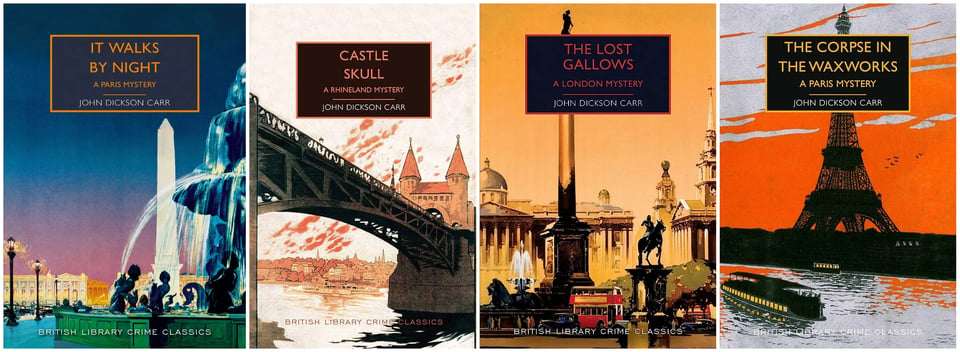
It Walks By Night (1930) My only previous exposure to Carr was The Blind Barber, which is a farce, so I was surprised to hear him described as a writer of atmospheric, Poe-ish mysteries. But It Walks By Night is definitely that. Carr wrote it in college (it was originally serialized in his university newspaper!) and it feels very young. The detective is Henri Bencolin, a French judge with a devilish, pointed hairdo (I unfortunately could not stop envisioning Dilbert’s boss). It’s very atmospheric as well as a locked room mystery, two things Rian mentioned specifically. I was off to the races. The 2020 British Library reissue includes the short story "The Shadow of the Goat," which I also recommend. (Youtube audiobook)

Castle Skull (1931) This was far and away my favourite, with its Scooby-Doo setting and dramatic double mystery. Really good stuff, I had a blast. Bencolin is always accompanied by an emotional support American called Jeff Marle, whom he relies on to ask blundering questions of beautiful young ladies. Carr was himself American, and I suspect that Jeff was either an attempt to relate to his peers or an outright caricature of someone. This is less a locked room mystery than it is an inaccessible castle mystery, and has Bencolin going up against a German detective in a really catty competition to solve the thing. I really loved the villain and resolution in this. (Youtube audiobook)

The Lost Gallows (1931) This one sees Bencolin and Marle in London, reunited with Bencolin’s old friend from Scotland Yard (who appears in the Bencolin short stories Carr published in his school paper, including the one reproduced in the British Library’s reissue of this book) and hunting a historical hangman. This also includes Carr’s first explicitly nonwhite character, a wealthy bachelor from Egypt, who doesn’t come off very well (but to be fair, neither do most anyone else in these books). The solution to the puzzle is satisfyingly neat and also sees Marle in genuine mortal peril, which was fun. (Youtube audiobook)

The Corpse in the Waxworks (1932) Bencolin and Marle return to Paris and discover a corpse held in the arms of a wax satyr. Although It Walks By Night was also set in Paris, this one feels really Parisian, with city politicians, blackmail, and a secret club. There’s an honest-to-god action sequence, and the first female character from Carr who I genuinely liked. Carr was definitely figuring things out as he went, writing these books. (Youtube audiobook)

The Hollow Man, or The Three Coffins (1935) Skipped forward to this one, which I saw repeatedly described as Carr’s ultimate locked room mystery. The original name of the book was The Hollow Man, but it was published in America as The Three Coffins, so you’ll see it as both. This features Dr. Gideon Fell, another of Carr’s detectives. I’m not entirely sure what he’s a doctor of, but he seems to know everyone he needs to in order to be pulled into mysteries. I enjoyed the story of this one, and the way it works is very good, but it does feel a little like Carr had become interested in the puzzle to the detriment of the story. Dr. Fell goes so far as to break the fourth wall and deliver a lecture on the best locked room mysteries, complete with citations, declaring to his companions that it’s relevant because they of course are also in a detective story. Wild stuff! (Libro.fm audiobook)

The Black Spectacles (1939) Another Gideon Fell, a poisoning case, and impossible not because of a locked room but because several people saw it happen and it was filmed. Fell doesn’t come into it until the midpoint, and his police contact is a young man who is having the worst time of his life on account of having recently fallen in love at first sight with the woman suspected of being the poisoner while visiting Pompeii (she did not notice him in Pompeii and is naturally distracted by other things). I had fun with this one! Fell lectures on the topic of “the male poisoner” which was. weird! (Youtube audiobook)

The Crooked Hinge by John Dickson Carr (1937). An imposter nobleman, a satanic cult, an antique automaton, the Titanic, and finally, of course: an impossible crime. Goes places, even by Carr’s standards.

He Who Whispers by John Dickson Carr (1946). This is the first post-war Carr I’ve read, and it definitely felt different. He uses the war, however—it signifies a very definite crux for many characters—and he plays around with psychological tropes which were on the rise at the time. Additionally, there is a sequence involving a lit dental display which I found thoroughly terrifying (I hate teeth).

And, covered in a previous entry: The Blind Barber.
portico: (benoit phone)
 When I worked at a comic shop, a regular told me one day that he had seen The Phantom Menace 5 times in the cinema. He adored star wars, so the thought that a star wars movie might be bad was untenable. Surely the problem must be with him! So he went back again, and again, and again...until presumably it left the theaters or someone in his life intervened. That's how I felt watching Wake Up Dead Man.

Reviews For The Easily Distracted:Wake Up Dead Man: A Knives Out Mystery -  Houston Press

Read more... )
portico: (benoit phone)
i'm always reading queer murder mysteries a little bit. never not reading queer murder mysteries. call it a load-bearing genre. however, right now i am only reading queer murder mysteries and doing so in a way which might be termed compulsive. i am also involved in the final days of a 4-month long renovation bleeding into the slowest house move imaginable. the two things might be related. anyway, here is an attempt to record my descent into wherever it is i'm going. have some queer mysteries.

the compulsion kicked off on february 19th, but i read one queer mystery before then, so i'm just going from feb 1st.

Read more... )
portico: (after the ball)
i'm really good at going to a bookshop, buying a book (or 3) and then stowing them safely in a stack on my shelves and reading library books and ebooks instead. yesterday, i went to the bookshop, bought 2 books, brought them home and decided to turn habit on its head by safely stowing them on my shelf and instead reading the LAST book i bought instead. so i'm like. 1 behind. 2 behind. anyway.

this was The Last Hour Between Worlds by Melissa Caruso and i can only assume i bought it because murder is mentioned on the back. i am who i am. but this book isn't a murder mystery. don't get me wrong, there are a LOT of murders, but it does some not-time loops to keep the murders from sticking (mostly) and it's pretty clear who is doing them. the last hour between worlds follows kembral thorne, a sort of private eye/bodyguard currently on leave due to having just had a baby. she's out on her own for the first time since her daughter's birth, and is tired and wrong-footed because of it. she's at a new year's party, surrounded by socialites and city elders, and Rika Nonesuch, her maybe-rival, maybe-friend (a burglar/assassin, a Cat to kem's Hound) is there looking really hot. they didn't part on the best terms. also there? a big ol' clock. shortly, everybody dies and kem has no choice but to be on the job again.

cat, hound, and assorted other guests end up trapped in what is essentially a high-concept bottle episode. the book begins with kem already at the party, and every subsequent loop begins the same way. caruso establishes that the loop occurs 11 times, once for every hour of the clock because that is, coincidentally, how many levels of unreality separate the real world ("Prime") from the Void, and the party is dropping through each of them, one by one. caruso does a good job of varying the loops--the theme of the party changes each time, different threads are followed, sometimes kem and rika leave the building and have to deal with the dangers outside, and of course, little by little they figure out what's happening and how to fight it. and throughout the whole night, kem is gradually coming to terms with how motherhood has changed her priorities and what that means for her, plus she and rika are working through a LOT of stuff.

i had a lot of fun with this! it's got a really good momentum--i read it in one sitting--and i thought the high concept stuff worked with the world-building really, really well. i wasn't surprised by any twist, which could have been boring except that caruso timed her reveals well, so there was always a solid emotional impact. much like that, kem-as-hound and rika-as-cat could have been predictable, except that both were so delightfully themselves that it works. it's written in first person from kem's pov, and anyone with both cats and dogs can tell you that watching a dog try to comprehend why a cat does anything is half the fun. my main complaint was that some of kem's language felt sort of millennial online in a way that pulled me out a bit every time. this is apparently the first book in a series, and i'm not sure if the appeal will transfer once you move past the party-dropping-through-layers-of-reality of it, but i guess time will tell. pun NOT intended.

portico: (su connie star eyes)
i had never heard of Perfect Days, a 2023 Wim Wenders film. it made the festival circuit and then came out in the US in 2024. at the end of 2024, my friend Jody listed it as her favourite film of the year, which was the first i became aware of it. i watched it on the flight back from Portland on New Year's Day, which had such persistent streaming issues that everyone's movies kept dropping out, but i was so enraptured with the film that i patiently poked at my screen each time until it came back. absolutely worth it.

「PERFECT DAYS」田中泯インタビュー公開 役所広司の技術をたたえ、出演振り返る : お茶の間@速報
Read more... )
portico: (gorey)
during the end of year sales i picked up a bunch of games on switch and steam. i brought my switch with me on my holiday travels, so i thought i might play them then. i didn't. i played part of one. i DID, however, end up trapped in my house while my city fixed its broken infrastructure for a full week, during which i plowed through the rest of them. here they are in chronological order. (i played all of these on switch, but they were all available on steam first, and many are also available on additional consoles now.)

several games follow )
portico: (phryne tea)
one of the perks of getting a laptop after years with a desktop was knowing that i would likely get into playing steam games again. This Bed We Made was at the top of my list. a point-and-click mystery game, this is less up my alley and more the alley itself.

This Bed We Made - Game Overview
set in 1950s Montreal, it follows Sophie, a hotel maid, throughout one day at work. on this day, she stumbles across some suspicious information about a hotel guest, makes the decision to investigate it, involves a coworker (who can become a romantic connection), and ultimately encounters a body. it's a relatively short game (3-6 hours, i think), but there's a lot of variation in the choices you make, which can impact what's revealed throughout the game, as well as how it ends. the game is also extremely queer, but the degree to which the player (and sophie) engage with that queerness depends on player choices. i also really enjoyed how the game's writing incorporated the player's natural (imo) inclination to open every drawer and paw through every suitcase into sophie's character. i always get a kick out of narratives which find uses for game mechanics or aspects of genre.

Read more... )

portico: (after the ball)
spend enough time reading historical romances and mysteries and you will learn to be wary of the 19th century India setting (unless you enjoy a storyline which is “british colonialism was neither complex nor problematic,” which i do not). i don’t remember exactly what alerted me to the fact that this one was different, but it is. Murder in Old Bombay* by Nev March is set in the 1890s in Bombay (Mumbai), and takes place amongst a population who are firmly caught in the middle of british colonialism. the protagonist, Jim Agnihotri is biracial, the son of an Indian mother and unknown white british father, raised in a british orphanage, and has spent his life in the british army. he is british enough to access whites-only army facilities but too Indian to be considered for ranks above Captain (because white brits can't be expected to take orders from an Indian).

the book opens on his recovering in an army hospital where he has been reading newspapers and a lot of sherlock holmes. buoyed by those two things he decides that he's going to offer himself as a detective to the family of two women who died after falling from a clock tower. the courts ruled it suicide, but the husband of one of the women wrote the newspaper to protest that verdict, and jim finds himself moved by the letter and disturbed by some of the facts of the case. and so begins his detective career.

this book is a mystery, but not a whodunnit. there isn't an eleventh hour reveal of the culprit, the way you would expect in a Christie. a lot of the book is jim doing legwork, and descriptions of the ways in which that was challenging in 1890s India. he travels to Lahore to investigate a lead, and ends up stuck there, caught between rebelling Afghan tribes and british troops, unable to leave or communicate with his employers due to stopped trains and downed telegraph lines. there's a lot of detail in the book, often ver loving, along those lines and others. i was continually charmed by the way march described the sounds of specific bird calls that jim noticed from time to time. it is a book that is very at home in its setting.

jim isn't the only character in an awkward social place specific to the conditions of colonization. his clients, the Framji family, are Parsees (or Parsis), descended from Persian refugees who migrated to India in the 7th century to escape religious persecution (they are Zoroastrian). they have aligned themselves with the british in many ways, sending their children to England for education and doing business primarily with the british or other Parsee families. the book isn't interested in passing judgement on them for this, in a calm acknowledgment of reality and shades of grey that i appreciated (especially after spending so many hours with veilguard's black-and-white morality). neither does the book whitewash the reality of conditions for Indians who were not able to access the same privileges as the Framji family.

overall, it was a delicious, crunchy piece of cultural pie with an interesting mystery and compelling romance baked in (although for my money the strongest relationship in the book is between jim and the entire Framji family, who he comes to love so very deeply). there were aspects that i think didn't really serve the book, but was enjoying myself so much that i didn't mind them. this was march's first book, so i am inclined to cut her slack. she is also a Parsee Zoroastrian, and included a piece of her family's own history in the mystery, giving it to the Framjis. i enjoyed that too. i'll definitely be checking out the sequels.

*bookshop.org affiliate link
portico: (aloy)
a lot has been said about the new dragon age game. i haven't seen most of it, just gotten a sense of the scale of the discourse like someone on a boat watching the shadow of a blue whale pass beneath them. i've read a few posts on tumblr, but otherwise haven't delved in--nor do i intend to. in general, my enjoyment of a game is not affected by other people's opinions of it. and i did enjoy this game! i played it all the way through once and have already embarked on a second play-through. despite this list of grievances, there is a lot in it to recommend it. the character creator is wonderfully diverse (you can be fat!) and i loved that your options for rook's voice went beyond male vs female and american vs british. the clothing and armor is wonderful. i loved just about every single companion character. that said.

is it a GOOD game? no. the combat is fun, the level up system is fine, there's no laborious crafting to be done, and visually it's a treat! but narratively, it's not great. for perhaps the first time ever, a game is bad because of woke.

spoilers for dragon age 2 and inquisition follow, very minor spoilers for veilguard )
portico: (ed spike)
 aaaaaand we're back! i forget how to write these.

castle malloy sees nancy in ireland to serve as maid of honor to kyler mallory, a brit who stayed with the drews as an exchange student some years before. nancy doesn't really understand why she's been asked to do this, as she and kyler are not close and seemingly have not kept in touch. but far be it from nancy to say no to something, so now she's outside a falling-down castle after wrecking her rental car outside the gates, throwing rocks at kyler's window because the old man who answered the door told her that the wedding was cancelled and to go away. fortunately for nancy's sunk costs, the wedding isn't cancelled it's just that the groom's disappeared. which is great for nancy who, like a herding dog, needs constant enrichment or she'll chew a door.


the facts are these: kyler inherited castle malloy (and simultaneously learned she was irish and that her grandfather had changed the family name to mallory) and was assured that it was habitable. which very well might be true but what is definitely also true is that half of it was exploded in WWII. like...literally.


it never rains in ireland so this is fine. nancy is going about, doing maid of honorly tasks for kyler (like printing the programs on a little letterpress, which is fun, and arranging the reception seating based on a set of logic problems, which is not), and also keeping an eye out for matt, the disappeared fiance. this eventually involves solving the mystery of what really happened in the 1940s, and what's that strange noise everyone keeps hearing? is there a ghost? (major spoilers follow)

no. )
portico: (benoit phone)
sci-fi mystery is one of those genres that is so up my alley (but still relatively niche) that i tend to pick them up automatically. so all i knew about Drunk on All Your Strange New Worlds by Eddie Robson was that it was a sci-fi mystery. it's also near-future sci-fi and alien sci-fi and translation sci-fi and...workplace sci-fi? is that a thing? if that combination of descriptors is making you think of julie e. czerneda, you're not alone! but crucially, also, there is a murder.

lydia is a translator for the logi cultural attaché in new york. she's in many ways an outsider: she's british, but not high class, she's never seemed to mesh with fellow translators, and she spends all her time either with her boss, an alien, or at high society cultural events becoming progressively drunk. because that's the thing about translating for the logi--only a small percentage of people can even learn to speak logisi, a telepathic language, and even if you can speak it, doing so results in a feeling of drunkenness. the drunkenness plus one very persistent theater producer lands lydia in some hot water, professionally, which is where she is when her boss is suddenly killed.

this is a fun whodunnit with an amateur sleuth (lydia) and a really good variety of elements in the mix. my favourite part of the book, however, was lydia's relationship with madison, the logi who is acting cultural attaché after the murder. lydia knows that her late boss, fitz, was at odds with madison, so she's disinclined to do madison's bidding, especially when it prevents her from the legwork required to investigate a murder. madison is very no-nonsense, and seemingly not nearly as cognizant of the toll that translation takes on the human brain as fitz was, and also maybe kind of a bitch? naturally, where the book really took off for me (and which gave me pleasant flashbacks to czerneda's survival trilogy) was when circumstances force lydia and madison onto the same side. just a fun book, start to finish.
portico: (ardeth bey)
my work gets the new york times, and i dutifully read each book world on monday mornings, partially for work and partially for myself. i love that the times has a romance reviewer now (i can still remember the DRAMA that erupted in romancelandia--not that we called it that then--when smart bitches, trashy books launched), and i love to read those reviews, but rarely do i actually read those books (a me problem, mostly! i do think the current trend in cartoony covers is objectively bad). but i'm very glad i read the most recent review, because it was there i learned about A Shore Thing by Joanna Lowell which, punny title and cartoon cover aside, was fantastic.

a shore thing is set in the 1880s in st. ives in cornwall, england. it's about murial pendrake, a botanist and plant hunter who is there to collect seaweed specimens and attempt to persuade local artist kit griffith to do paint the specimens for a presentation. for himself, kit relocated to st. ives for the light (long beloved by artists) but has since lost the ability to paint and has opened a bicycle shop instead. they meet when kit crashes his bicycle to avoid colliding with murial.

there's a lot of really delicious historical stuff happening in this book. i love the bicycle element, a still-new technology which does a good job of setting a scene of a society actively undergoing change, and the ways in which women are seeing the opportunities for more freedom within the change while men are still drawing lines in the sand preventing them from taking advantage. there's talk of pre-raphaelites, women making inroads in art academies, and growing communities of sapphists. these are all things that i have read extensively about, and it was a treat for me specifically to encounter them.

kit is what we would now call trans, and the conflict at the heart of his character is between the groups he found belonging with in the past--sapphists and sisterhoods--and the person he knows himself to be--unquestionably male. he's also a rake, which is frankly wonderful. i loved that at no point does the book allow to to be in doubt that guy is hot as hell, knows it, and is very willing to use that to his advantage. murial is certainly never in doubt about it.

murial herself is less complicated a character but no less interesting. she is curious and ambitious and utterly bloody-minded (she agrees to take part in a multi-day bicycle tour despite having never ridden before and explains that she'll certainly complete it because she's just not somebody who gives up on things). her best friend is a gay man, but aside from him she hasn't had any experience with queer people. she's trying her best with kit, and it rings very true. also: the sex is great. really hot and really respectful of kit which is, in its way, also really hot.

i liked this book a whole lot. it's fun and funny (i haven't even mentioned the "mutton wheelers" bicycle club) and navigates around some really terrible realities of being queer or a woman or a queer woman in19th century england with a deftness that never dips into hopelessness. i can see there being complaints about the unproblematic-ness of characters--murial and kit are aware of and disapproving of the imperial project, for example, in a way that feels more 21st century than 19th century. but i let it slide because at least that anachronism and others are definitely coming from a place of scholarship rather than, say, performative social media purity. i was not surprised when i reached the end and discovered that the book was written in close collaboration with a queer historian, Mir Yarfitz, who is also trans and Lowell's partner. 

great stuff. there is, perhaps, hope for romance yet. (maybe. if they kill the cartoons.)
portico: (after the ball)
 i picked upA Letter to the Luminous Deep by Sylvie Cathrall at my local bookshop, lured in by the twin promises of epistolary and scholars building an archive. it could have gone very, very wrong, but happily for me this book was everything it promised and more.

the book opens with a letter from E. Cidnosin, who lives in an underwater house, to classification scholar Henery Clel, about two elongated fish she saw from her bedroom window and could not find in his book on the subject. from this letter we learn that E. is the daughter of an accomplished architect who built her home--The Deep House--which is the only one of its kind. E. lives there alone, as both of her siblings have left to become scholars elsewhere. her voice is funny, self-depreciative, and curious. you can't help liking her.

the next letter is from E.'s sister Sophy to Henery's brother Vyerin about their siblings, both of whom, we learn, have died. a year has passed since they lost them, and both of them have been grief-stricken. however, sophy located a cache of letters as well as henery's day book in the ruins of The Deep House--also lost--and has come to vyerin with a proposition: what if between the two of them they reconstructed the last year of their siblings' lives through the letters they left behind? they construct an archive, sending each other their siblings' letters and sometimes other relevant correspondence or documents in the order in which they occurred. they also come to like one another quite a lot--deciding to meet at a market with both of their spouses and eventually foregoing the letter writing entirely in favor of finishing the archive in person at vyerin's house.

i liked so many things about this book--the epistolary aspect (done in such a way that the reader always knows where the letter originated from and why), the slow revelation about the universe in which these people live, the sweet and unique romance between e. and henery (two very sweet and unique people), as well as the romance between sophy and her wife, which developed during the period being reconstructed. the prose is wonderful, the world-building deft and interesting. every character stands out on the page. e. suffers from debilitating anxiety, and the way this was presented and talked about in a world which has a very different relationship to mental health than ours was interesting and i appreciated it. 

i finished this book a few weeks ago but have struggled to write about it, because it's (ironically!) hard to classify. it's the softest of sci-fi, but still inventive and gripping. it's about a character with obsessive-compulsive disorder, but also not about that at all. it's a romance between two people, and two other people, and also four people (and two children). it's a murder mystery--or is it? anyway. i loved it. 5 out of 5.
portico: (Default)
i love to haunt used bookshops, particularly when traveling, and i'm always looking for interesting golden age mystery paperbacks. i hit the jackpot with this one, found in dogtown books in gloucester, ma.


i'd never read any of carr's work before, but i knew of him from the shedunnit podcast, and i love a boat as a setting for a mystery. having now read it, i'm not sure what to think about this being my first carr--it's apparently very unusual for him! it was likewise unusual for golden age mysteries on the whole.

to begin with, the book's "detective" was only nominally dr. gideon fell. he is not present on the boat where the events occur, and is playing armchair detective while henry morgan, a mystery writer and acquaintance of his who was aboard, describes it all to him. as a result, you are only with fell in the very beginning, an intermission in the middle while morgan has a drink before he loses his voice, and finally, at the end. i found him unobjectionable, although i have gathered that other readers think him very irritating, so perhaps this was the ideal book in which to encounter him. the other unusual element of the blind barber is that it's a farce. my copy begins with a forward from someone delicately explaining that this is going to be a funny book and if you don't like that sort of thing, you should take yourself elsewhere. i do, so i enjoyed it, although i think of 1934 as still fairly early in the long life of the detective novel as we now know it, so it's funny to think that the genre had already reached a point where writers were lampooning it. it's a GOOD lampoon, however, and a good farce. i have acted in farces before, and their defining element in my experience is that folks MUST be rushing in and out of doors all the time. at that, this book excels.

here's the plot: our main cast of characters are morgan (british), curt warren (american, diplomatic corps, nephew of a Certain Personage in american government), peggy glenn (british, the sort of intrepid girl who is indigenous to detective stories, niece of a french puppeteer, also on board), and capt. thomassen valvick (norwegian, retired sea captain, acquainted with the ship's captain, loves to tell a tale). the thing kicks off when some film that warren has of his uncle dunking on every other world leader he can think of on film, which warren thought he destroyed but survived is stolen from his stateroom. they lay a trap with more of the film, fail to capture the culprit and instead assault the ship's captain, who is transporting a valuable emerald necklace from a viscount's suite to the safe, and in the course of the whole affair the necklace goes missing, a badly injured woman is both found and vanishes, and the rest of the film is lost. if this doesn't make plain the core point of the book, then i will: these people are so bad at solving mysteries.

the rest of the book is near nonstop slapstick action, and i had a wonderful time. one of the cleverest things about the blind barber is that it follows the rules of fair play (meaning that every clue that the reader would need to solve the crime is in the book), and to prove it carr even provides footnotes throughout fell's explanation telling the reader where precisely the clue was revealed in the book. morgan bemoans his stupidity in not solving it himself, but fell points out, correctly, that he was far too busy falling over tables and such.

i had a couple of issues with the book, the first being the phonetic language used for anyone with an accent--this was the worst for capt. valvick, the norwegian, who spoke a LOT, but it came up with other characters, too. additionally, there's some mild, period-typical racism, and curt warren ends the book in blackface.

all in all, while it may not have made me want to read more books featuring dr. gideon fell, i do think i'll be reading other ones by john dickson carr.

portico: (after the ball)
a little while ago, i added a bunch of books that i liked the sounds of to my storygraph to read list from a post that was going around on tumblr of forthcoming queer books, and then i forgot about them. but storygraph dutifully emails me whenever one of these books has come out, and i trust that past door had my best interests at heart, and check if the library has it. this is how i ended up reading Floating Hotel by Grace Curtis, and past door really knocked it out of the park with this one.

floating hotel is about a hotel in space. it's set in a far, far distant future, where mankind has left earth behind in order to mine other planets for all they're worth and then move on. there's an emperor, one who has been alive for 500 years, and massive wealth inequality. the book is aware of all of these things, but mostly comes at them from the side. the book is about the hotel.

Read more... )

portico: (Default)
In my eternal quest to know about more queer architects, i heard Horace Gifford's name a few times, enough that i added him to the roster of people i hunt for books about in secondhand bookstores. i never seemed to find anything, so i finally looked online (my preference is to stumble across things serendipitously, but sometimes action is required) and discovered the problem: there is a single book about gifford, and despite only being 10 years old it is wildly out of print. like, copies priced at $500 out of print. so, i did the next best thing and requested a copy via ILL.


gifford was active on fire island (primarily in the Pines) for 20 years, throughout the 1960s and 70s. he established a vernacular architecture in a place which previously had been home to modest beach shacks. he was gay, and handsome, and died tragically of complications due to AIDS in 1992. much like in the case of perkins harnly, that we have any record of gifford at all aside from his houses is due to one person's willingness to hold onto his papers. sometimes i think about how many people who died during that era who will surely be forgotten by history and i'm overwhelmed. i'm so glad that horace gifford wasn't one of them.

fire island modernist is wonderful. )
portico: (train)
Amaza Lee Meredith was born in 1895 in Lynchburg, Virginia, and went on to establish the arts department at Virginia State University (an historic Black college/university in Peterburg) and build the only "international style" home in virginia. i first learned about her from the new angle voices podcast, and as a queer virginian and house architecture enthusiast was immediately desperate to know more. so i read Amaza Lee Meredith Imagines Herself Modern: Architecture and the Black American Middle Class by Jacqueline Taylor.

this was taylor's first book, and it's based ( i believe) on her dissertation, although she also contributed a chapter about meredith to a book called Suffragette City about women's contributions to the built environment. i'll be interested to read that piece, because although meredith left her archives to VSU, which includes letters and plans, she left behind absolutely no writing (aside from scrapbooks and sketches) about her home or the homes she planned/built in Sag Harbor, NY. this resulted in a book that is very strong in its chapters about meredith's growing up and schooling years (of which there were many, as she went to college for a teaching certificate, then later a BA and, subsequently, an MA in arts education) and the state of education theory and opportunities available to upwardly mobile black people in the early 20th century. this was fascinating and extremely well-researched. unfortunately, i was much more in it for the houses.


Read more... )
Page generated Sep. 14th, 2026 10:27 am
Powered by Dreamwidth Studios