![[personal profile]](https://www.dreamwidth.org/img/silk/identity/user.png)
Carrs I Read
Dec. 23rd, 2025 03:49 pmI read a bunch of stuff by John Dickson Carr to prepare for Wake Up Dead Man, and then more after that just because he's good! I reported on them in various newsletters, but here they all are in one place.
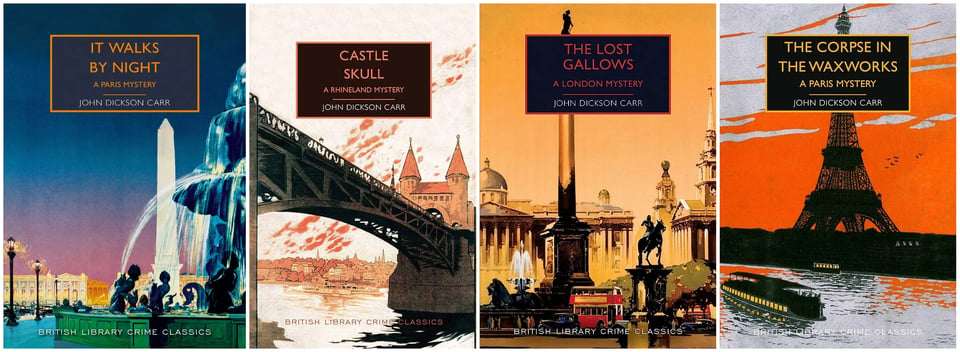
It Walks By Night (1930) My only previous exposure to Carr was The Blind Barber, which is a farce, so I was surprised to hear him described as a writer of atmospheric, Poe-ish mysteries. But It Walks By Night is definitely that. Carr wrote it in college (it was originally serialized in his university newspaper!) and it feels very young. The detective is Henri Bencolin, a French judge with a devilish, pointed hairdo (I unfortunately could not stop envisioning Dilbert’s boss). It’s very atmospheric as well as a locked room mystery, two things Rian mentioned specifically. I was off to the races. The 2020 British Library reissue includes the short story "The Shadow of the Goat," which I also recommend. (Youtube audiobook)
Castle Skull (1931) This was far and away my favourite, with its Scooby-Doo setting and dramatic double mystery. Really good stuff, I had a blast. Bencolin is always accompanied by an emotional support American called Jeff Marle, whom he relies on to ask blundering questions of beautiful young ladies. Carr was himself American, and I suspect that Jeff was either an attempt to relate to his peers or an outright caricature of someone. This is less a locked room mystery than it is an inaccessible castle mystery, and has Bencolin going up against a German detective in a really catty competition to solve the thing. I really loved the villain and resolution in this. (Youtube audiobook)
The Lost Gallows (1931) This one sees Bencolin and Marle in London, reunited with Bencolin’s old friend from Scotland Yard (who appears in the Bencolin short stories Carr published in his school paper, including the one reproduced in the British Library’s reissue of this book) and hunting a historical hangman. This also includes Carr’s first explicitly nonwhite character, a wealthy bachelor from Egypt, who doesn’t come off very well (but to be fair, neither do most anyone else in these books). The solution to the puzzle is satisfyingly neat and also sees Marle in genuine mortal peril, which was fun. (Youtube audiobook)
The Corpse in the Waxworks (1932) Bencolin and Marle return to Paris and discover a corpse held in the arms of a wax satyr. Although It Walks By Night was also set in Paris, this one feels really Parisian, with city politicians, blackmail, and a secret club. There’s an honest-to-god action sequence, and the first female character from Carr who I genuinely liked. Carr was definitely figuring things out as he went, writing these books. (Youtube audiobook)
The Hollow Man, or The Three Coffins (1935) Skipped forward to this one, which I saw repeatedly described as Carr’s ultimate locked room mystery. The original name of the book was The Hollow Man, but it was published in America as The Three Coffins, so you’ll see it as both. This features Dr. Gideon Fell, another of Carr’s detectives. I’m not entirely sure what he’s a doctor of, but he seems to know everyone he needs to in order to be pulled into mysteries. I enjoyed the story of this one, and the way it works is very good, but it does feel a little like Carr had become interested in the puzzle to the detriment of the story. Dr. Fell goes so far as to break the fourth wall and deliver a lecture on the best locked room mysteries, complete with citations, declaring to his companions that it’s relevant because they of course are also in a detective story. Wild stuff! (Libro.fm audiobook)
The Black Spectacles (1939) Another Gideon Fell, a poisoning case, and impossible not because of a locked room but because several people saw it happen and it was filmed. Fell doesn’t come into it until the midpoint, and his police contact is a young man who is having the worst time of his life on account of having recently fallen in love at first sight with the woman suspected of being the poisoner while visiting Pompeii (she did not notice him in Pompeii and is naturally distracted by other things). I had fun with this one! Fell lectures on the topic of “the male poisoner” which was. weird! (Youtube audiobook)
The Crooked Hinge by John Dickson Carr (1937). An imposter nobleman, a satanic cult, an antique automaton, the Titanic, and finally, of course: an impossible crime. Goes places, even by Carr’s standards.
He Who Whispers by John Dickson Carr (1946). This is the first post-war Carr I’ve read, and it definitely felt different. He uses the war, however—it signifies a very definite crux for many characters—and he plays around with psychological tropes which were on the rise at the time. Additionally, there is a sequence involving a lit dental display which I found thoroughly terrifying (I hate teeth).
And, covered in a previous entry: The Blind Barber.
It Walks By Night (1930) My only previous exposure to Carr was The Blind Barber, which is a farce, so I was surprised to hear him described as a writer of atmospheric, Poe-ish mysteries. But It Walks By Night is definitely that. Carr wrote it in college (it was originally serialized in his university newspaper!) and it feels very young. The detective is Henri Bencolin, a French judge with a devilish, pointed hairdo (I unfortunately could not stop envisioning Dilbert’s boss). It’s very atmospheric as well as a locked room mystery, two things Rian mentioned specifically. I was off to the races. The 2020 British Library reissue includes the short story "The Shadow of the Goat," which I also recommend. (Youtube audiobook)

Castle Skull (1931) This was far and away my favourite, with its Scooby-Doo setting and dramatic double mystery. Really good stuff, I had a blast. Bencolin is always accompanied by an emotional support American called Jeff Marle, whom he relies on to ask blundering questions of beautiful young ladies. Carr was himself American, and I suspect that Jeff was either an attempt to relate to his peers or an outright caricature of someone. This is less a locked room mystery than it is an inaccessible castle mystery, and has Bencolin going up against a German detective in a really catty competition to solve the thing. I really loved the villain and resolution in this. (Youtube audiobook)
The Lost Gallows (1931) This one sees Bencolin and Marle in London, reunited with Bencolin’s old friend from Scotland Yard (who appears in the Bencolin short stories Carr published in his school paper, including the one reproduced in the British Library’s reissue of this book) and hunting a historical hangman. This also includes Carr’s first explicitly nonwhite character, a wealthy bachelor from Egypt, who doesn’t come off very well (but to be fair, neither do most anyone else in these books). The solution to the puzzle is satisfyingly neat and also sees Marle in genuine mortal peril, which was fun. (Youtube audiobook)
The Corpse in the Waxworks (1932) Bencolin and Marle return to Paris and discover a corpse held in the arms of a wax satyr. Although It Walks By Night was also set in Paris, this one feels really Parisian, with city politicians, blackmail, and a secret club. There’s an honest-to-god action sequence, and the first female character from Carr who I genuinely liked. Carr was definitely figuring things out as he went, writing these books. (Youtube audiobook)
The Hollow Man, or The Three Coffins (1935) Skipped forward to this one, which I saw repeatedly described as Carr’s ultimate locked room mystery. The original name of the book was The Hollow Man, but it was published in America as The Three Coffins, so you’ll see it as both. This features Dr. Gideon Fell, another of Carr’s detectives. I’m not entirely sure what he’s a doctor of, but he seems to know everyone he needs to in order to be pulled into mysteries. I enjoyed the story of this one, and the way it works is very good, but it does feel a little like Carr had become interested in the puzzle to the detriment of the story. Dr. Fell goes so far as to break the fourth wall and deliver a lecture on the best locked room mysteries, complete with citations, declaring to his companions that it’s relevant because they of course are also in a detective story. Wild stuff! (Libro.fm audiobook)
The Black Spectacles (1939) Another Gideon Fell, a poisoning case, and impossible not because of a locked room but because several people saw it happen and it was filmed. Fell doesn’t come into it until the midpoint, and his police contact is a young man who is having the worst time of his life on account of having recently fallen in love at first sight with the woman suspected of being the poisoner while visiting Pompeii (she did not notice him in Pompeii and is naturally distracted by other things). I had fun with this one! Fell lectures on the topic of “the male poisoner” which was. weird! (Youtube audiobook)
The Crooked Hinge by John Dickson Carr (1937). An imposter nobleman, a satanic cult, an antique automaton, the Titanic, and finally, of course: an impossible crime. Goes places, even by Carr’s standards.
He Who Whispers by John Dickson Carr (1946). This is the first post-war Carr I’ve read, and it definitely felt different. He uses the war, however—it signifies a very definite crux for many characters—and he plays around with psychological tropes which were on the rise at the time. Additionally, there is a sequence involving a lit dental display which I found thoroughly terrifying (I hate teeth).
And, covered in a previous entry: The Blind Barber.